What Artificial Intelligence Taught Me About Family Photographs and Humility
AI caught me off guard.
I thought I was preparing to teach about artificial intelligence, In the end, it taught me a lesson in humility.
It happened while I was preparing a presentation about MyHeritage’s new tool, Scribe AI.
As I always do before teaching a class, I started testing the tool myself. Not on new photographs, not on mysteries that had just landed on my desk, not on documents I had never seen before. I chose a family photograph I already knew.
I had looked at this photo dozens of times and it felt like I already “decoded” it.
I was sure I understood everything there is to understand about it, or at least, so I thought.
Then I uploaded one of them to Scribe AI.
At first, I read the results with professional curiosity.
Then I raised an eyebrow.
And then I simply went quiet.
Suddenly, there they were: details I had never noticed before.
Not because they were hidden, not because I needed Sherlock Holmes’s magnifying glass to see them, they had been there all along, I had simply approached the photograph with the feeling of: “I already know this one.”
And that is where it caught me.
The first lesson I received from artificial intelligence was not about technology.
It was about humility.
A Family Photograph Is Not Only About Who Is in It
When we look at a family photograph, the first thing we usually search for is the people.
Who is this? When was it taken? Where was it taken? Is that Grandma? Is that the uncle? Who is the child standing in the middle?
And that makes sense. We are genealogists. We look for people, relationships, names, and stories.
But a family photograph tells us much more than that.
It speaks through the clothing, the posture, the chair someone is sitting on, the background, the sign hanging behind them, a medal on a jacket, the faint writing at the bottom of the image, the tears, the border, the type of print, and the physical condition of the paper. And this is where Scribe AI became, for me, is not just a technological tool, but an extra pair of eyes.
Not eyes that replace me as a researcher.
Eyes that remind me to pause.
What Can Scribe AI Teach Us From a Photograph?
When you upload a photograph to Scribe AI, the tool does not stop at a general description. It tries to break the image down into several layers of meaning.
It can summarize the scene: who appears in the photograph, how they are positioned, whether it is a studio portrait or an outdoor image, and whether it looks formal or more casual.
It can suggest historical context: whether the clothing, setting, or atmosphere fits a certain period. It may notice whether the image seems connected to postwar life, migration, military service, urban life, or rural life.
It can suggest an estimated date based on fashion, hairstyles, hats, suits, dresses, photographic style, or the condition of the print.
It can suggest a possible location based on clues such as landscape, surroundings, signs, architecture, objects, or cultural features.
And it can identify small visual clues: medals, uniforms, chairs, stamps, inscriptions, signs, jewelry, accessories, or background details that our eyes sometimes simply skip.
And that is exactly where the genealogical value begins.
Not because artificial intelligence “knows everything.”
It does not.
But because it helps us ask better questions.
The Chair, the Hat, and the Detail I Did Not See
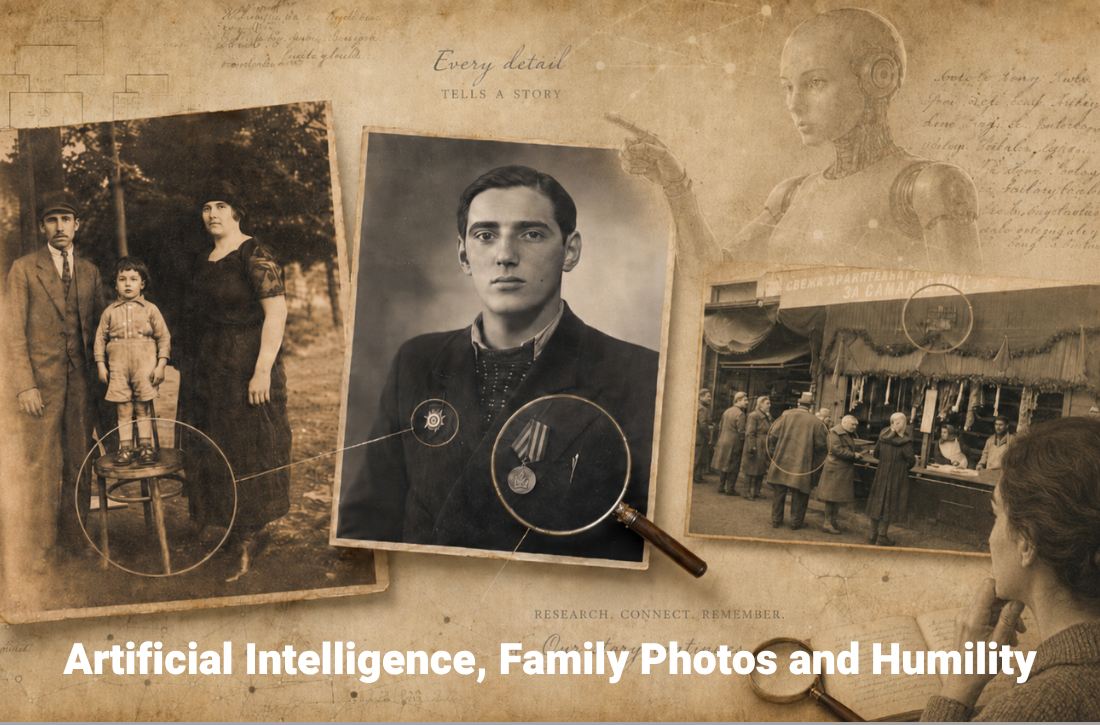
This is one of the family photographs I uploaded
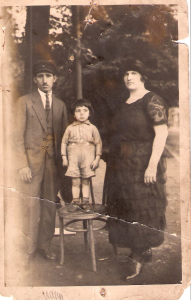
A family of three: a man, a woman, and a young child in the center. A sepia-toned outdoor portrait, formal posture, probably from the early 20th century. I could see that much myself.
But Scribe AI began pointing out details: the woman’s hat, the shape of her dress, the man’s flat cap, the suit, the formal pose, the chair the child was standing on.
Yes, the chair. A simple wooden chair, or so it seemed.
Something I would never have stopped to examine.
But the tool treated it as a visual clue that could fit a particular European setting and period. Does the chair alone prove a location? Of course not.
Can it join the clothing, the photographic style, the family context, and other records to strengthen a hypothesis? Absolutely.
And that is an important lesson in family photographs: sometimes one detail does not give us the answer. It is the accumulation of small details that begins to tell the story.
A Familiar Photograph Can Still Surprise You
In another example, I uploaded a portrait of my maternal grandfather.
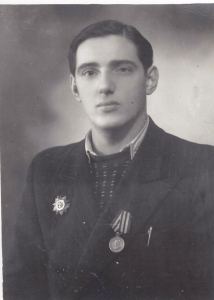
This is a photograph I have known all my life.
Truly, all my life.
I knew the family story about his military service. I knew he had been wounded. I knew the family narrative connected to this image.
But Scribe AI drew my attention to details I had never really stopped to notice.
For example, his jacket was not simply dark. It had subtle pinstripes, and there was a pen attached to his breast pocket.
Now, you could say: really, a pen? What can you possibly learn from a pen?
But that is exactly the point, not every small detail gives us a clear answer.
But every small detail can open a question.
Was the pen connected to his profession? To education? To the way he chose to present himself? To a civilian identity after military service? To a desire to appear respectable, organized, and formal?
Maybe. Maybe not.
But now I have a question I had not asked before. And that matters.
A Medal Is Not Just A Decoration
In my grandfather’s photograph, the medals suddenly gained another layer of research value. Not just: “He was wearing medals.”
But: Which medals? What were they awarded for? Is there an official record? Can I find a service file, an award record, or a military document?
Scribe AI suggested looking in relevant military memory databases, and in that moment, a visual detail in a photograph became a real research direction.
That is one of the most important things we can learn from analyzing photographs with the help of artificial intelligence:
A photograph can be a gateway to records.
A medal can lead to military documentation.
A uniform can point to a unit or time period.
A sign in the background can lead to a place.
A photographer’s stamp can lead to a city.
Faint writing can point to a language, a family, or a country.
An estimated date can lead us to a census, immigration record, or civil document.
The photograph is not the end of the road.
It is a starting point.
But Do Not Fall in Love With the Answer
This is where I need to pause. I am not saying we should accept everything artificial intelligence tells us as absolute truth. Not at all.
Scribe AI can make mistakes.
It can suggest a date that needs checking, identify a location only as a probability, interpret an object in a way that still needs verification, It can misread unclear handwriting or blurred text. Sometimes it may sound confident when we, as researchers, need to remain cautious.
So our role does not disappear. On the contrary.
Artificial intelligence does not replace genealogical thinking. It challenges it.
It gives us directions, but we need to test them.
It points to details, but we need to ask what they are worth.
It suggests context, but we need to compare that context with documents, family knowledge, historical sources, and additional evidence.
It is not the final authority. It is a research partner.
The Real Lesson: Seeing Without Already Knowing
And that brings me back to the lesson in humility.
Because long before we ask what Scribe AI can do, there is another question:
How do we approach the photograph? Do we come to it open? Or do we come to it with an answer already in mind?
Because when I tell myself, “I know this photograph,” I am actually reducing the possibility of seeing something new in it.
Experience is a wonderful thing.
It gives us confidence, tools, professional language, and the ability to recognize patterns and understand context. But sometimes, without noticing, that same experience can also make us a little blind.
We see too quickly.
We conclude too quickly.
We place the image into a familiar category that already exists in our mind.
And this is not true only of photographs.
It is true of documents, headstones, family stories, testimonies, memories.
Sometimes we are so sure we know what is in front of us that we stop truly looking.
How Should We Work With Photographs Using AI?
If you want to use tools like Scribe AI to analyze family photographs, here are a few principles worth keeping in mind.
1. Start with the most original version of the image you have. Do not rush to crop the edges, repair the damage, enhance the image, or remove the “imperfections.” Tears, borders, writing, stamps, and edges may all be part of the evidence.
2. Look in layers. Begin with the overall scene: who is in the photograph, how they are positioned, and what type of image it is. Then move to the details: clothing, objects, background, language, markings, posture, and the condition of the photograph.
3. Treat every conclusion as a hypothesis. An estimated date is not a final date. A possible location is not proof. The identification of an object is the beginning of an investigation.
4. Compare the analysis with what you already know. Do the ages make sense? Does the place fit the family’s timeline? Does the clothing match the period? Are there documents that support the suggestion?
5. Pay attention to what surprises you.
If the tool points to a detail you had not noticed before, do not dismiss it too quickly.
Ask yourself: Why did I not see this before? And what might it open?
In the End, This Is Not a Lesson About AI. It Is a Lesson About Research.
I
sat down to prepare a lesson about Scribe AI.
I
wanted to show how the tool transcribes, translates, identifies, analyzes, and
suggests research directions. And
all of that is true. It
really does impressive things.
But
the most important lesson I received from it was something else.
It
reminded me that even after years of experience, even after looking at the same
photograph dozens of times, even when I think I have seen everything, there may
still be one small detail waiting for me to notice it.
And
sometimes, in order to see it, we do not need new eyes.
We
need a little less certainty.
A
little more curiosity.
And
a little more humility.
Because
in the end, artificial intelligence is not here to take the research away from
us.
It
is here to remind us how to look again.
And
perhaps that is the most important thing it can teach us.