
RootsTech 2026 Recap: The AI Revolution in Genetic Genealogy
The RootsTech 2026 conference in Salt Lake City will be remembered as the definitive turning point where Artificial Intelligence transitioned from a "nice-to-have" feature to the core engine of genealogical research. As a specialist following these trends closely, I’ve put together this comprehensive guide to the major launches from the industry giants.

Smart User Experience & Advanced Document Analysis
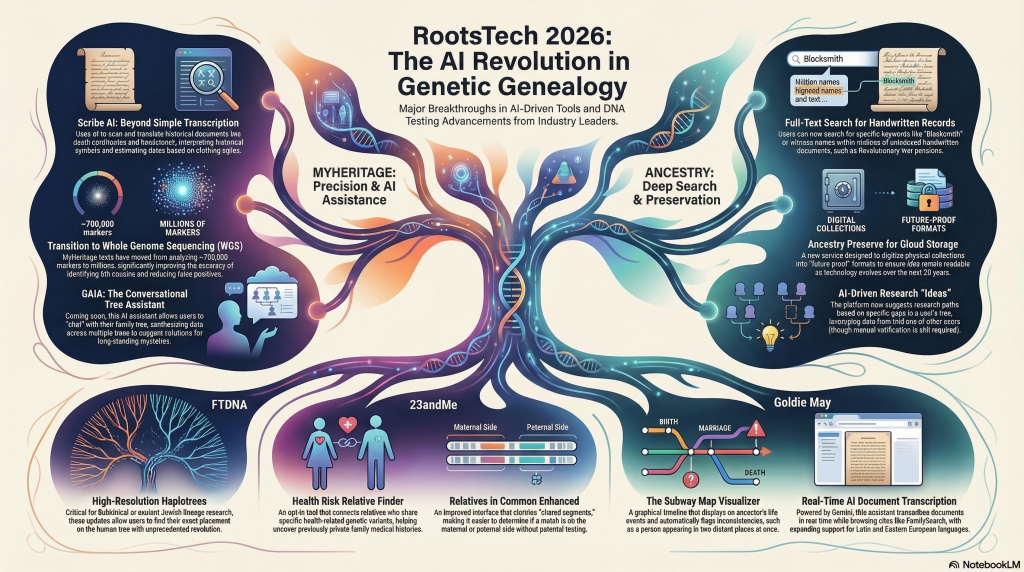
Scribe AI: A groundbreaking tool using AI to scan, transcribe, and translate historical documents (letters, death certificates, headstones). It identifies difficult handwriting, interprets historical symbols, and even estimates dates based on clothing styles in photos.
Essential Info: It supports multiple languages, including Hebrew and Yiddish—perfect for decoding community ledgers or weathered gravestones. Note: Using Scribe AI typically consumes "credits" or requires a Complete subscription.
Whole Genome Sequencing (WGS): The company announced that all its DNA tests have been upgraded to Full Genome Sequencing.
Essential Info: This is a massive shift. While old tests looked at ~700,000 markers, WGS examines millions. This significantly improves accuracy for distant relatives (5th cousin+) and reduces "false positives."
GAIA (Coming Soon): An AI-based genealogical assistant that allows you to "chat" with your family tree.
Essential Info: GAIA doesn't just answer questions; it synthesizes data from multiple trees to suggest solutions for long-standing family mysteries.

Full-Text Search & Digital Preservation
Full-Text Search for Handwritten Records: A major breakthrough allowing you to search for specific words within millions of handwritten documents (like Revolutionary War pensions) without a manual index.
Essential Info: Previously, we could only search by indexed names. Now, you can search keywords like "Blacksmith," a specific street address, or names of wedding witnesses who were never officially indexed.
Ancestry Preserve: A new service designed to help users digitize their physical family collections and save them in the cloud.
Essential Info: The service promises "future-proof" formats, ensuring your files won't become unreadable in 20 years as technology evolves.
Ideas Feature: A tool within the "Person" page that suggests research paths based on gaps in your tree.
Essential Info: While it leverages the "wisdom of the crowd" from millions of other trees, always remember to verify these suggestions against primary sources!

Focusing on the Global Human Tree
World’s Largest mtDNA & Y-DNA Haplotrees: Significant updates to their haplotrees, allowing testers to find their exact placement on the human tree with unprecedented resolution.
Essential Info: For those researching Rabbinical lineages or ancient Jewish origins, this update is critical for identifying specific sub-clades that branched off centuries ago.
Family Finder Whole Genome: A new version of their autosomal test based on genome sequencing, providing enhanced health and ethnic insights.
Essential Info: FTDNA still allows raw data uploads from other companies, but to fully benefit from WGS advantages, you'll need to take their specific dedicated test.
Family Collaboration & Health
Health Risk Relative Finder: A tool allowing users to connect with relatives who share specific health-related genetic variants.
Essential Info: This requires active "Opt-in" from both parties. It’s a powerful tool for uncovering family medical histories that may have been kept private.
Relatives in Common Enhanced: An improved interface showing how much DNA your shared matches share with each other.
Essential Info: This helps identify "shared segments," making it much easier to determine if a match is from the maternal or paternal side without needing to test your parents.

Your Professional Research Assistant
Automatic Research Log: The software automatically records every page you visit, every search you perform, and every document you open.
Essential Info: The log can be exported as a CSV or Excel file, allowing you to share your research process or keep a local backup.
AI Assistant (Powered by Gemini): A research assistant that transcribes handwritten documents in real-time while browsing FamilySearch or Ancestry.
Essential Info: While it works best in English, recent upgrades allow it to analyze Latin and Eastern European documents impressively. Note: A Pro subscription is required for full AI access.
Subway Map: A visual tool displaying an ancestor's life events on a graphic timeline, automatically flagging inconsistencies (like being in two distant places at the same time).
Essential Info: This tool pulls data directly from your FamilySearch tree. If you work on Ancestry, you will need to "import" the data for the map to update.
Summary and Conclusions
RootsTech 2026 proved that while technology is making research faster, it also requires us to be more critical. AI can make mistakes in transcription or logic, so manual verification remains an essential part of our work. The move toward WGS marks the end of the old "Microarray" era and the beginning of a new age of precision.